Your Brain Quits Before You Do: The 15-Minute Deal That Gets Studying Started
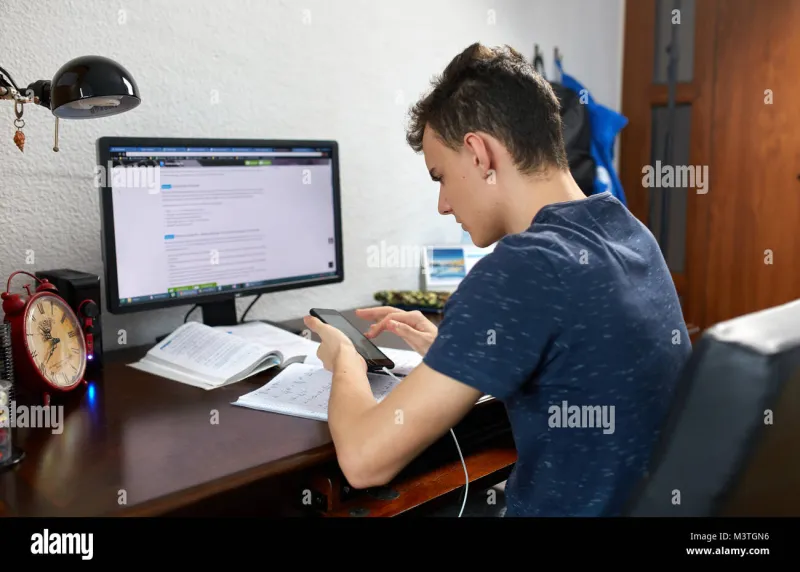
Photo: student starting homework at desk with timer laptop notebook, via c8.alamy.com
Picture this: it's 7:30 on a Tuesday night. Your psych exam is in four days. You've got the textbook open, the desk is (mostly) clear, and you have made exactly zero progress because you've spent the last 40 minutes reorganizing your Google Drive and texting your roommate about dinner.
Sound familiar? Here's the thing almost nobody tells you: you weren't failing at studying. You were failing at starting. And those are two completely different problems with two completely different fixes.
The Start Is a Different Sport Than the Work
Think about the last time you finally sat down and got into an assignment. Maybe it was writing a paper where the first paragraph took an hour and the last three took twenty minutes. Maybe it was problem sets where question one felt impossible and by question six you were in a rhythm.
That's not a coincidence. Behavioral scientists have a name for the resistance you feel before beginning a task: it's sometimes called task initiation friction, and it's driven largely by the anticipation of effort — not the effort itself. Your brain runs a quick cost-benefit scan before you commit to anything, and studying looks expensive from the outside. So it pitches you alternatives. Laundry. Snacks. One more episode.
The catch? That cost estimate is almost always wrong. Once you're actually working, the dread evaporates because your brain stops forecasting and starts doing. The pain lives almost entirely in the on-ramp.
Which means the smartest study habit isn't about studying harder or longer. It's about making the on-ramp as small and non-threatening as possible.
Enter the 15-Minute Deal
Here's the whole strategy, and it fits on a sticky note:
Commit to 15 minutes. Just 15. Then you're allowed to stop. Genuinely allowed.
Not "15 minutes and then probably I'll keep going." A real deal, where stopping at 15 is a legitimate, guilt-free outcome. That last part matters more than you'd think — if your brain smells a bait-and-switch, it stops trusting the deal, and the trick stops working.
Why 15? Because it's short enough that your brain doesn't mount a defense. Saying "I'm going to study for three hours" triggers every avoidance instinct you have. Saying "I'm going to do 15 minutes" barely registers as a threat. It's smaller than a Netflix episode. It's shorter than the doom-scroll spiral you'd fall into instead.
And here's the part that feels like a cheat code: most of the time, you won't stop at 15. Once you're moving, momentum does the heavy lifting. Psychologists call this the Zeigarnik effect — unfinished tasks occupy space in your mind and create a natural pull to complete them. Once the task is open, your brain wants to see it through. The 15-minute deal isn't really about the 15 minutes. It's about getting the engine turned over.
Why It Beats "Motivation" Every Time
A lot of students treat motivation like fuel: wait until you feel like it, then drive. But motivation is a response, not a prerequisite. It tends to show up after you start, not before. You've felt this — the workout you dreaded that left you energized, the essay that felt awful at word one and fine by word four hundred.
Top students aren't waiting for a feeling. They've built a starting ritual — a repeatable, low-friction sequence that gets them into the work before the dread has time to organize a protest. The 15-minute deal is the simplest version of that ritual.
How to Run It
- Pick one specific task. Not "study for chem" — that's too vague for your brain to engage with. Try "do problems 1–10 from chapter 7." Specificity kills ambiguity, and ambiguity is where procrastination breeds.
- Set a visible timer. Phone face-down, timer where you can see it. A visible countdown makes the commitment feel finite and real.
- Work with full permission to stop. At 15:00, actually pause and ask: keep going or done? If done, you keep the win. No guilt.
- Log it. More on that below — this is the part most people skip, and it's the part that makes the habit stick.
The Momentum Tracker
Habits are built on evidence. If you can see your streak of started sessions, starting gets easier each time. Grab a simple sheet of paper or a notes app and build this:
| Date | Task (specific!) | Started? (15 min) | Kept going? | Stopped at 15? |
|---|---|---|---|---|
| 10/7 | Chem ch. 7 problems 1–10 | ✅ | ✅ | — |
| 10/8 | Essay intro paragraph | ✅ | ❌ | ✅ |
Two things to notice about that sample week:
- The "stopped at 15" column is a win, not a failure. You honored the deal. That keeps the contract trustworthy. Print this grid, stick it inside your planner or notebook, and fill it in daily for two weeks. Most students find that by day ten, they've stopped at 15 maybe twice. The other thirteen sessions? Momentum did the rest.
When 15 Minutes Feels Like Too Much
Some nights, even 15 is a hard sell. Shrink the deal, don't break it. Five minutes of flashcards. One page of notes. The size of the commitment matters less than the fact that you keep it. A five-minute session you actually did beats a three-hour session you planned and never started — every single time.
The Bottom Line
You don't have a motivation problem. You have a starting problem — and starting is a skill you can train like any other. Make the deal small, keep it honest, track the evidence. Do that for two weeks and the question stops being "how do I make myself study?" and becomes "why did I ever think this was hard?"
That's what reaching your full mark actually looks like: not one heroic all-nighter, but a few hundred honest 15-minute deals, kept.