Your Returned Exam Is a Map, Not a Verdict: The 20-Minute Post-Test Autopsy
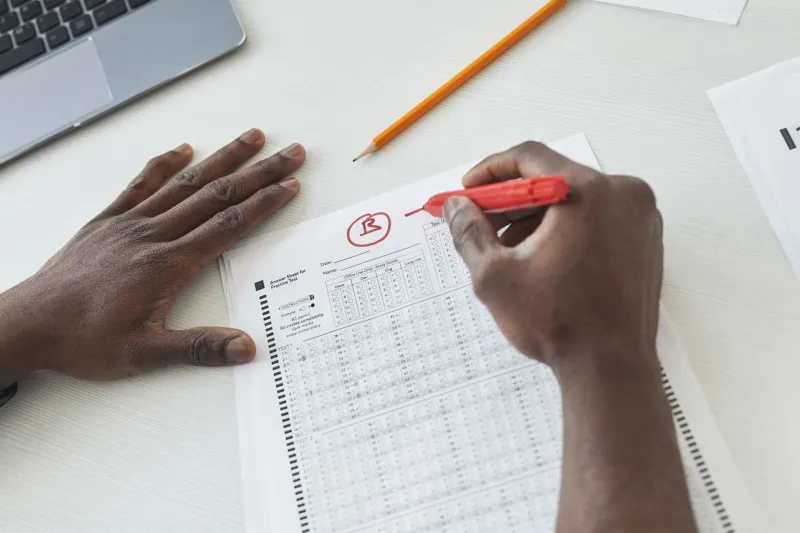
You get the exam back. There is a red 72 in the corner, a few angry circles, and a comment that looks like it was written by someone who had already graded 140 of these. You flip through it, feel a hot wave of embarrassment, tell yourself you will do better next time, and slide it into the folder where old syllabi go to die.
That folder is not a study tool. The returned exam is.
Most students treat a graded test like a verdict. It is not. It is a map of exactly where your preparation broke down, written by the one person who knows what the next test will look like. You paid for that information with tuition, stress, and maybe a Friday night. The least you can do is spend 20 minutes reading it.
The Ten-Minute Mood Is Not a Study Plan
Feeling bad is allowed. It is also useless after the first few minutes. The productive move is to convert the emotion into categories. Not 'I am bad at chemistry,' but 'I lost four points because I misread the question, three because I did not know the formula, and two because I panicked and changed an answer I had right.'
That is the difference between a mood and a plan.
The tool is a post-exam autopsy. It sounds dramatic. It is just a structured review. You are going to classify every missed point, log the pattern on one page, and schedule one small retry before the next test. No highlighters. No all-nighter. No new planner.
Classify the Damage: Three Buckets
Every lost point belongs in one of three buckets. The buckets matter more than the score.
Knowledge gap. You did not know the concept, formula, definition, or date. You could not have reasoned your way to the answer because the raw material was missing. This is the easiest bucket to fix: re-read, make a retrieval question, ask your TA, do three practice problems.
Process error. You knew the material but executed poorly. You misread 'except.' You skipped a step. You ran out of time because you spent 12 minutes on a two-point question. You forgot units. You did not show work. This is not a knowledge problem; it is a systems problem.
Panic move. You changed a correct answer. You blanked on a word you knew. You wrote a paragraph when the question asked for a sentence. You second-guessed yourself into a wrong turn. Panic errors are real, and they usually get worse when you do not review them.
Write the bucket next to every red mark. Do not judge yourself. Just sort.
One Page, Five Columns
Open a blank document or grab an index card. Make five columns:
| Question | Points lost | Bucket | Actual fix | Retry date |
|---|
The first column is the question number. The second is the damage. The third is the bucket. The fourth is a specific action, not a vibe. 'Review chapter 4' is a vibe. 'Redo problems 4.2 and 4.5 without notes, then check with the key' is a fix. The fifth column is when you will do it. Put a date and a time. 'Later' is not a date.
This page is now more valuable than the exam itself. The exam tells you what happened. The tracker tells you what to do differently.
The Pattern Is the Point
One mistake is noise. Three mistakes of the same type is a pattern.
If six of your nine lost points are process errors, your problem is not intelligence. It is test-taking mechanics. You need a timing plan, a read-the-question-twice rule, and maybe a watch on the desk. If most lost points are knowledge gaps in one topic, you need a targeted review session, not a general 'study more' guilt spiral.
If panic moves dominate, you need practice under mild pressure. That means timed mini-quizzes, not endless re-reading. You need to rehearse the moment, not just the material.
This is where a lot of students accidentally waste the next two weeks. They feel bad about the score and respond by re-reading everything. That is like getting a flat tire and repainting the car. The autopsy tells you which tire.
Schedule the Retry Before the Folder Closes
A review without a retry is just journaling. You need one small comeback attempt.
Pick a 20-minute window in the next 72 hours. Take the questions you missed, cover the answers, and redo them from a blank page. Say your reasoning out loud. If you get stuck, mark the exact step where it fell apart. Then check your work.
Do not redo the entire exam. That is punishment, not practice. Redo the missed points and the one or two questions you got right for the wrong reason. Those are landmines.
If the retry reveals that you still cannot explain a concept, that is useful information. Email the professor or go to office hours with a specific question. 'I can do the calculation, but I cannot explain why we divide by n minus one' is a much better question than 'Can you go over the exam?'
What This Looks Like in Real Life
A student I worked with got a 68 on a biology midterm. Her first instinct was to buy a new planner and color-code everything. We did the autopsy instead. She had lost 14 points to process errors: three questions where she missed the word 'not,' two where she ran out of time, and one where she erased a correct answer.
She did not need to study more biology. She needed to slow down on the first pass and budget eight minutes for the last section. On the next exam, she used the same tracker, lost fewer points to the same old stuff, and finished with time to check. The score went up. More importantly, she stopped treating every test like a character judgment.
The Full-Mark Mindset
Reaching your full potential does not mean never seeing a red mark. It means treating the red mark as data. The students who improve fastest are not the ones who never fail. They are the ones who fail, open the folder, and ask a better question.
Twenty minutes. Three buckets. One page. One retry. That is the whole system. Do it before the exam becomes a story you tell yourself about who you are.