What One Night Without Sleep Actually Costs You (The Receipt Might Hurt)
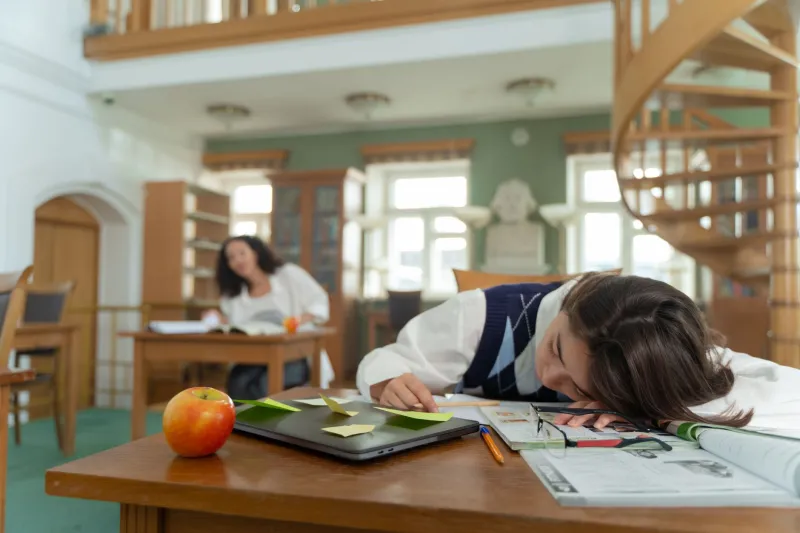
There's a moment every college student knows: it's 11 p.m., the exam is at 8 a.m., and you're doing the math. If I sleep four hours, that's four more hours of studying. If I skip sleep entirely...
Stop. Close the laptop. Because that math is broken, and we're going to fix it — with receipts.
The Invoice You Never See
An all-nighter feels like it costs nothing. Nobody charges your card. But run it like a business decision and the ledger gets ugly fast.
Line item one: memory consolidation. Your brain files away what you learned while you sleep — specifically during deep sleep and REM. Skip the night, and you're essentially writing a paper and never hitting save. Sleep researchers have found that sleep-deprived people can retain roughly 40% less of new material than rested ones. That 9 p.m. to 5 a.m. cram session? A big chunk of it evaporates before you sit down.
Line item two: next-day performance. After 24 hours awake, your cognitive impairment is comparable to a blood alcohol content of 0.10% — above the legal driving limit in all 50 states. You're about to take a high-stakes exam legally drunk, minus the fun.
Line item three: the GPA tax. Studies tracking college students consistently show that irregular and insufficient sleep correlates with lower grades — and the effect compounds. One rough night becomes a bad week becomes a shaky semester.
Line item four: the recovery period. You don't just lose one day. Sleep debt drags your focus down for days afterward, which means the next class, the next assignment, the next study session all run at reduced capacity.
All-Nighter vs. Spaced Week: The Actual Math
Let's compare two students facing the same Friday exam.
Student A crams Monday through Thursday nights, sleeps 5 hours, then pulls a full all-nighter Thursday. Total study time: roughly 18 hours.
Student B studies 45 minutes a day, Monday through Thursday, then does one 90-minute review Friday morning after a full night's sleep. Total study time: about 5 hours.
Student B wins, and it's not close. Here's why: spaced repetition — reviewing material across multiple days — is one of the most replicated findings in cognitive science. Each time you return to information after a gap, your brain has to work harder to retrieve it, and that effort cements it. Cramming creates familiarity, not memory. Familiarity fails you the moment the question is phrased differently than your flashcards.
So Student A spends 18 hours to walk in exhausted, retrieving maybe half of what they saw. Student B spends 5 hours and walks in rested, with material that actually sticks. If your time is worth anything at all, the all-nighter is the most expensive study strategy on the market.
The Shutdown Ritual: Your New Night-Before-Exam Playbook
You can't always control how prepared you feel. You can control how you end the day. Here's the routine we'd put on a poster:
1. Set a hard stop (90 minutes before bed). At a fixed time — say 9:30 p.m. — studying ends. Not "when I finish this chapter." A clock, not a feeling.
2. Do a brain dump. Take five minutes and write down everything still rattling around: formulas, terms, that one concept you're shaky on. Getting it on paper tells your brain it's safe to stop rehearsing.
3. One-page review only. Skim a single summary sheet — yours or one you made earlier. This is a victory lap, not a new lesson. Nothing new after the hard stop.
4. Pack tomorrow like it's a flight. ID, calculator, water bottle, lucky pen. Every decision you remove from the morning is a decision your tired brain doesn't have to make.
5. Screens down, lights low. Give yourself 30 minutes of wind-down. The blue light and the doom-scrolling can both wait.
6. Set two alarms, then let go. Lying awake worrying about oversleeping is worse than the risk itself. Trust the system.
Reframe the Fear
Here's what's really driving most all-nighters: anxiety. Sleeping feels like giving up control. But you're not choosing between studying and sleeping — you're choosing between keeping what you studied and throwing away a third of it.
Sleep isn't the reward at the end of your preparation. It's the final step of it. The students who score at the top aren't the ones grinding until sunrise — they're the ones who understood that closing the laptop at 9:30 was studying.
The exam starts in the morning. But the winning move happens the night before.