Before Your Feet Hit the Floor: The Morning Habit Quietly Draining Your GPA
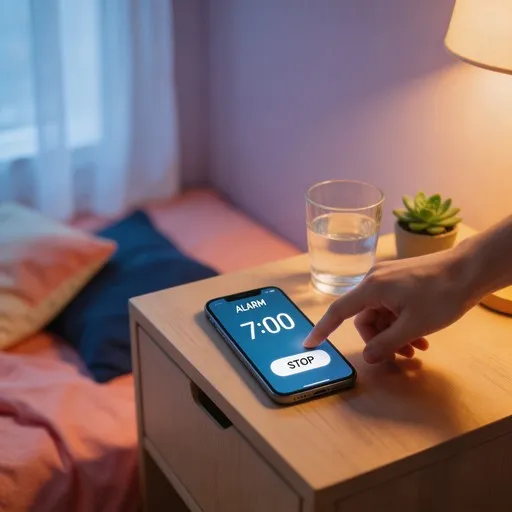
Photo: student alarm clock morning phone across room dorm, via images.stockcake.com
Let's do a quick inventory. Your alarm goes off. Before your feet touch the floor, your thumb has already found the Instagram icon. You're lying in the dark, squinting at a screen, watching someone else's life happen while yours hasn't technically started yet.
It feels harmless. It feels like waking up gently. According to the academic coaches we talked to, it might be the single most expensive habit in your entire study routine — and it costs you nothing but attention you didn't know you were spending.
What the Scroll Actually Costs
Here's the problem with reaching for your phone the second you wake up: you're not consuming content, you're reacting to it. Notifications, DMs, group chats about last night, a professor's email about an exam — your brain goes from zero to defensive mode before you've even brushed your teeth.
Dr. Amara Fields, an academic coach who works with first-year students at three Big Ten schools, puts it bluntly: "Students think their focus problem starts at the library. It starts at the bedside table. Every morning you train your brain that distraction is the default setting."
The math is ugly when you run it. If that morning scroll — plus the fragmented, twitchy attention it leaves behind — shaves even 30 minutes of quality focus off your day, that's three and a half lost study hours a week. Over a 15-week semester, you're donating more than 50 hours of prime brain time to your notifications. That's more than most students lose to an entire finals-week panic. Except this one happens every single day, quietly, with no dramatic all-nighter to blame it on.
Why Your Brain Treats It Like a Slot Machine
The first hour after you wake up, your brain is still shifting out of sleep-mode brainwaves. It's uniquely suggestible in that window — which is great if you feed it intention, and terrible if you feed it 47 TikToks in a row.
"You're essentially programming your attention span for the day," says Marcus Lee, a study-skills tutor in Austin, Texas. "If the first thing you practice is rapid task-switching, guess what you'll be doing in your 9 a.m. lecture? Rapid task-switching."
That's why you can sit through a full lecture and retain almost nothing. It's not that the material got harder overnight. It's that you trained your brain to swipe away from anything that doesn't deliver a dopamine hit within four seconds.
The Two-Minute Replacement Routine
The good news: you don't need a $400 sunrise alarm clock, a cold plunge, or a 5 a.m. journaling practice. The coaches we spoke to all converge on a version of the same boring, effective routine.
1. Keep the phone across the room. Not on the nightstand. Across the room, or better, outside the room. If your phone is your alarm, buy a $12 clock and stop pretending otherwise. The physical distance matters more than willpower ever will.
2. Water and light before words. A glass of water and thirty seconds of actual daylight — window counts, porch is better. Light tells your body clock you're awake; water rehydrates the brain you're about to ask to do calculus.
3. Name the day's one big thing. Before any input, say out loud or write down the single most important academic task of the day. Not five tasks. One. "Draft the psych lab intro." "Do 20 orgo practice problems." This gives your brain a target before the world gives it a hundred.
4. No screens for the first 15 minutes. That's it. Fifteen minutes. You'll survive. The group chat will still be there, and honestly, it will be exactly the same.
The Compounding Effect Nobody Talks About
Here's why this beats most study hacks: it compounds. Every morning you start with intention instead of input, you make it slightly easier to focus later that day. Every focused study session makes the next one easier to start. By week six, you're not a different person — you're just a person whose mornings stopped leaking.
Compare that to the popular alternative: downloading another productivity app, buying another planner, waiting for motivation to arrive. Those all require future-you to behave better. The morning fix only requires present-you to put a phone somewhere else.
Start Tomorrow, Not Someday
If you want to test this without committing to a lifestyle change, run a one-week experiment. Phone across the room, water, one named task, 15 screen-free minutes. Track nothing fancy — just notice whether your first study block of the day starts faster.
Most students who try it don't go back. Not because mornings become magical, but because they finally get to find out what their brain does when it isn't starting the day in a stranger's comment section.
Your semester's grade curve isn't set in one dramatic all-nighter. It's set in a hundred tiny mornings. This one starts across the room.