The Paper Test: Five Study Jobs That Belong on a Desk, Not a Screen

Photo by Photo by Vitaly Gariev on Unsplash on Unsplash
Paper versus digital is not a personality quiz. You are not a 'paper person' or a 'tech person.' You are a student with a specific task and a limited amount of attention. The right medium depends on what the task asks your brain to do.
That is the whole argument. It is also why the debate gets so noisy. People compare a handwritten grocery list to a collaborative document and call it science. The better question is simpler: for this study job, does paper remove friction or add it?
Here are five tasks where paper usually wins, three where digital clearly wins, and a 30-second rule for choosing before your next session.
The Five Paper Jobs
1. Math and science problem sets
Paper is good at showing work. When you solve a problem on a screen, it is easy to skip steps, copy a line from above, or let the software do the algebra. On paper, you have to commit. The page shows your reasoning, including the ugly parts. That makes it easier to find the exact step where you went wrong.
Paper also gives you space. You can draw a diagram, write a side calculation, and cross something out without opening a menu. For problem-heavy courses, that spatial freedom is not nostalgia. It is a workflow.
2. Essay outlines
An outline is a hierarchy, and paper makes hierarchy physical. You can see the thesis at the top, the main claims underneath, and the evidence branching off. You can cross out a whole section and redraw it in 10 seconds. You can spread three pages on a desk and find the weak link.
Digital outlines can work, but they invite endless formatting. You start with a simple list and end up adjusting indentation for 20 minutes. Paper keeps you at the level of ideas.
3. Timed exam simulations
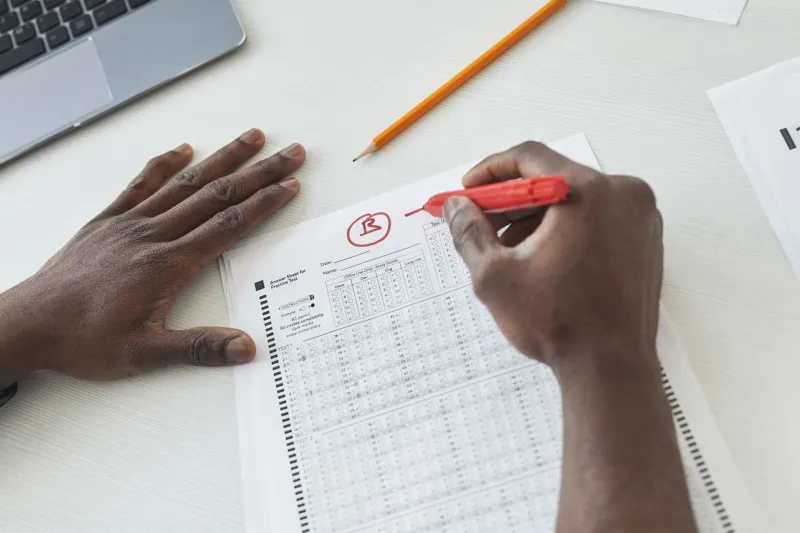
If your exam is on paper, practice on paper. If it is a Blue Book exam, practice in a Blue Book. If it is a Scantron, practice filling in bubbles without losing your place. The goal is to rehearse the conditions, not just the content.
A screen adds notifications, tabs, and the temptation to check a definition. Paper does not. A timer on your phone, a stack of blank pages, and a pen can simulate the real thing better than a PDF with a progress bar.
4. Flashcard sorting
Digital spaced-repetition systems are excellent for scheduling. But the physical act of sorting cards into piles is a different kind of review. You can make a 'know it cold' pile, a 'shaky' pile, and a 'no idea' pile. You can shuffle. You can carry 15 cards in your pocket.
The sorting itself is retrieval practice. You have to look at the prompt, produce an answer, and make a judgment. That is more active than scrolling through a deck while half-watching YouTube.
5. Annotation-heavy readings
If you need to mark up a dense article, a printed page gives you margins. You can draw arrows, circle repeated terms, and write 'why?' next to a claim. The physical act of marking slows you down in a good way. You cannot highlight the whole page as easily, which is a feature.
For PDFs, annotation tools are fine. But for the reading you actually need to wrestle with, paper often keeps you in the argument instead of in the toolbar.
The Three Digital Wins
1. Searchable reference notes
If you need to find a definition, a date, or a formula across 80 pages of notes, digital wins. Control-F is not cheating. It is a retrieval tool. The key is to search after you have tried to remember, not instead of trying.
2. Spaced-repetition scheduling
Anki, Quizlet, and similar tools handle the scheduling math that humans are bad at. They can bring a card back on the right day and track your accuracy over time. That is a genuine advantage. Use the algorithm for timing, and keep the actual recall work in your head.
3. Collaborative drafting and feedback
Group projects, peer review, and shared notes are better in a document with comments and version history. You do not need five people emailing 'final_v3_REAL.docx.' Digital wins here because the task is coordination, not solitary retrieval.
The 30-Second Decision Rule
Before you start, ask two questions.
First: does this task require me to generate, manipulate, or organize ideas under time pressure? If yes, paper is usually better. Math sets, essay outlines, and exam simulations all fit.
Second: does this task require me to search a large body of information, schedule repetitions over weeks, or coordinate with other people? If yes, digital is usually better. Reference notes, flashcard scheduling, and group docs fit.
If the answer is 'both,' split the task. Outline on paper, then draft in a document. Practice problems on paper, then log your missed concepts in a spreadsheet. The medium is not a religion. It is a tool.
A Quick Warning About 'Paper Feels Better'
Paper is not automatically superior. A messy paper system can be just as distracting as a messy digital one. The point is not to romanticize notebooks. The point is to choose the medium that makes the work harder to fake.
If paper helps you show your work, slow down, and retrieve instead of recognize, use it. If digital helps you find, schedule, and collaborate, use it. Then get back to the actual studying.
Reaching your full potential is not about having the prettiest notes. It is about matching the tool to the task, one session at a time.