Treat Your Hardest Class Like a Sport: A Semester Training Plan for the Course That's Trying to Kill You
Every semester has that one class. The one other students warn you about in hushed tones. Organic chemistry. Multivariable calculus. AP Bio. Whatever your campus calls it, the game plan is the same — and most students don't have one.
Here's a mindset shift that changes everything: stop treating your hardest course like a to-do list and start treating it like an athletic season. Nobody walks onto the field for the championship without months of structured practice. So why do students expect to ace a brutal course by showing up and hoping?
Preseason: Weeks 1–3
Athletes don't wait for game day to get in shape, and you don't wait for the first exam to build your system.
Scout the opponent. Read the syllabus like a coach watches game film. When are the exams? How much does each one count? Is there a curve? Write every date into your calendar now — not the week before.
Set your training schedule. Block three to four recurring study sessions per week for this course, 60–90 minutes each. Same days, same times. Consistency beats intensity, every time.
Learn the fundamentals cold. Every hard course builds on prerequisites. Spend the first weeks drilling the foundations until they're automatic, because week eight will not wait for you to relearn week two.
Regular Season: Weeks 4–10
This is where seasons are won or lost — and where most students coast until the first bad exam score wakes them up.
Practice like you play. Every study session should involve solving problems from memory, not re-reading notes. Retrieval practice is your scrimmage. Passive review is stretching. Do more of the former.
Run weekly checkpoints. At the end of each week, ask yourself three questions:
- Can I explain this week's core concept out loud, without notes, in under two minutes?
- Can I solve a problem from this week cold?
- Where exactly did I get stuck, and what's my plan for that gap?
If you can't answer all three, that's your weekend priority — not a crisis, just film review.
Call a coaching timeout when you need it. Around week six or seven, motivation dips for everyone. That's not a character flaw; it's physiology. When it hits, don't quit and don't white-knuckle it — adjust. Shorten sessions, form a study group, hit office hours, or take one genuine rest day. Coaches call timeouts to reset the game plan, not to forfeit.
Playoff Push: Weeks 11–15
Simulate game conditions. Two weeks before the final, take at least two full practice exams under real constraints: timed, closed-book, no phone. This exposes gaps while there's still time to close them.
Taper, don't cram. In the final week, shift from learning new material to consolidating what you know. Review error logs, redo missed problems, and protect your sleep like it's the starting lineup — because it is.
Show up warm. The morning of the final, do a light 30-minute review of your weakest topics. That's it. Athletes don't run a marathon before the race.
Your Weekly Planning Template
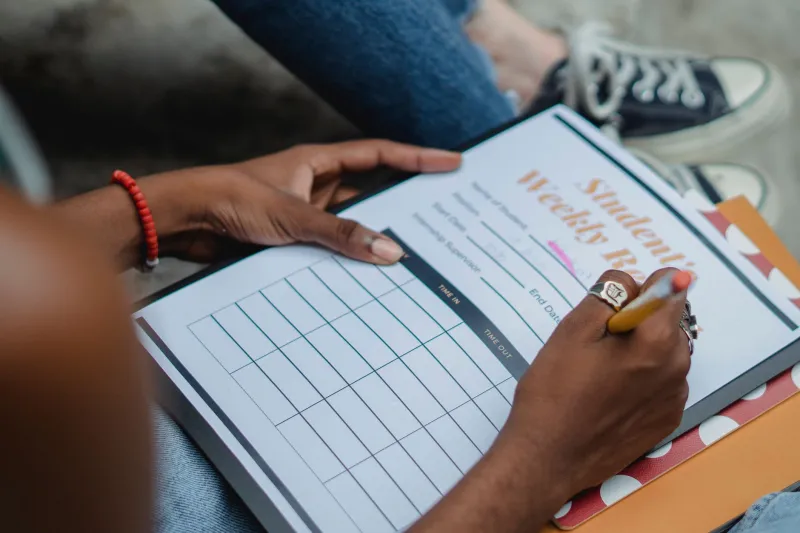
Copy this into a doc or planner and fill it in every Sunday:
- This week's topics: ___
- Study blocks (day/time): ___
- Problems to solve (not just read): ___
- Checkpoint quiz results: ___
- Gaps + plan to close them: ___
- One thing I'm dropping to protect these blocks: ___
That last line matters. A season plan only works if something else gets cut to make room for it.
The students who survive the hardest class on campus aren't tougher than you. They just trained like it was a season instead of surviving it like a siege. Game on.